Seasonal exterior perimeter barriers protect residential building envelopes against seasonal biological migration. Knox County sits in the Ridge-and-Valley physiographic province, where high relative humidity and heavy…
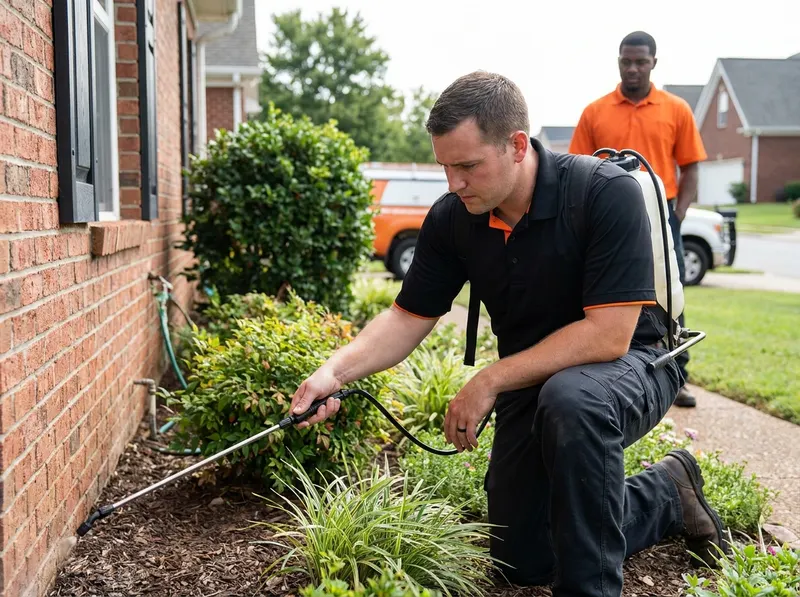
Seasonal exterior perimeter barriers protect residential building envelopes against seasonal biological migration. Knox County sits in the Ridge-and-Valley physiographic province, where high relative humidity and heavy deciduous leaf canopies create damp ground litter. During prolonged summer heat waves or sustained autumn rains, ground-dwelling arthropods migrate outward from mulch beds and crawlspace vents toward conditioned living spaces. Installing an exterior protective barrier breaks this line of transit. AmberTrail Extermination applies microencapsulated formulations adhering to the guidelines of the US EPA Pesticide Programs and the Tennessee Department of Agriculture Pesticide Division. These long-chain compounds bond to masonry, stone veneers, and poured concrete, remaining active across changing weather patterns. Technicians treat weep screeds, crawlspace access hatches, basement thresholds, and hose bibbs, establishing a comprehensive zone that neutralizing crawling pests before they breach the interior drywall.
Knoxville microclimates dictate specific barrier configurations across distinct residential architectural profiles. Historic brick homes in Fourth and Gill and Old North Knoxville feature elevated brick piers, stone stem walls, and deep perimeter vegetation that retain moisture. In these environments, liquid barrier products pair with water-insoluble granular matrices formulated under NPIC pesticide science guidelines to penetrate thick wood mulch and ground ivy. Slab-on-grade subdivisions built throughout West Hills, Bearden, and Rocky Hill require continuous horizontal barriers along brick-to-foundation expansion joints where invasive odorous house ants establish trail networks. Riverside properties in Island Home Park and heavily wooded lots in Sequoyah Hills and South Knoxville (SoKno) encounter heavy camel cricket and smokybrown cockroach pressures driven by the thermal buffer of the Tennessee River. These sites require expanded band treatments around garage aprons, patio slabs, and outbuildings to control pest populations before insects gather against foundation edges.
Homeowners weighing perimeter barrier applications must evaluate single-point pest elimination against perimeter boundary exclusion. Interior spot applications treat insects only after they emerge inside baseboards, pantry cupboards, or bedrooms, providing zero deterrent against incoming cohorts. Conversely, a dedicated exterior barrier intercepts perimeter pests outdoors, preventing indoor chemical exposure. The trade-off is mechanical durability: sunlight degradation, heavy runoff, and organic debris accumulation naturally degrade exterior barrier materials within 60 to 90 days. Continuous coverage across East Tennessee's four distinct pest cycles requires planned quarterly re-applications. To maintain compound integrity, landscape maintenance must adhere to standards established by the UT Extension Institute of Agriculture: grading soil away from wood framing, trimming foundation-adjacent shrubs back twelve inches, and clearing gutter overflow directed by Knox County Stormwater Management guidelines.
Executing proper application requires a distinct three-step protocol. First, technicians inspect the outer structure from grade line to eave, mapping localized moisture pockets, termite shelter tubes, and unsealed conduit lines according to NPMA pest management standards. Second, technicians sweep spider webbing and mud dauber tubes from exterior soffits and window frames before laying a continuous 3-foot by 6-foot perimeter band using low-pressure spray rigs regulated by OSHA occupational safety standards. Third, water-resistant synthetic pyrethroid or neonicotinoid granules are distributed into dense ground covers and ornamental beds to intercept subterranean foraging trails, matching application limits verified through the CDC National Center for Environmental Health and the USGS water quality monitoring programs. Property owners can call (865) 460-6433 to confirm perimeter dimensions or request technical specifications.
Every job gets a firm, written price after a free on-site visit.
Tell us about your seasonal exterior perimeter barriers job in Knoxville and we'll send a clear, written quote, usually the same day.
 AmberTrail Extermination